A matrix is a function: it sends every point of the plane somewhere else. Its columns tell us everything, because they are where the basis vectors \(\mathbf{e}_1 = (1,0)\) and \(\mathbf{e}_2 = (0,1)\) land.
Before running: the matrix below has columns \((0.87, 0.5)\) and \((-0.5, 0.87)\). What do you think it does to the plane?
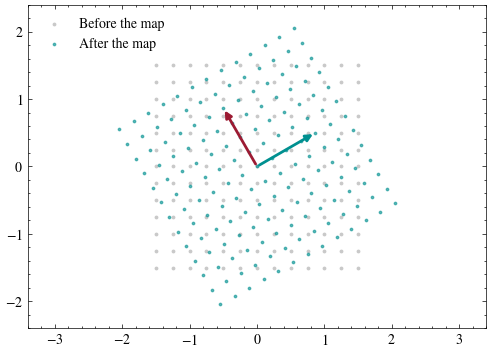
import numpy as npimport matplotlib.pyplot as pltimport matplotlib.cbook as cbookimport scienceplotsplt.style.use(["science", "no-latex"])TEAL, CARDINAL, GRAY ="#009090", "#9c1b33", "#c9c9c9"theta = np.pi /6A_rot = np.array([[np.cos(theta), -np.sin(theta)], [np.sin(theta), np.cos(theta)]])ticks = np.linspace(-1.5, 1.5, 13)gx, gy = np.meshgrid(ticks, ticks)points = np.vstack([gx.ravel(), gy.ravel()]) # one point per columndef show_map(A): mapped = A @ points fig, ax = plt.subplots(figsize=(7, 4.2)) ax.scatter(points[0], points[1], s=3, color=GRAY, label="Before the map") ax.scatter(mapped[0], mapped[1], s=3, color=TEAL, alpha=0.6, label="After the map")# the two arrows are the two columns of A: where e1 and e2 land ax.annotate("", xy=A[:, 0], xytext=(0, 0), arrowprops=dict(arrowstyle="-|>", color=TEAL, linewidth=2)) ax.annotate("", xy=A[:, 1], xytext=(0, 0), arrowprops=dict(arrowstyle="-|>", color=CARDINAL, linewidth=2)) ax.set_xlim(-3.4, 3.4) ax.set_ylim(-2.4, 2.4) ax.set_aspect("equal") ax.legend(frameon=False, loc="upper left") plt.show()show_map(A_rot)
A rotation by \(30^\circ\), and the two arrows (where \(\mathbf{e}_1\) and \(\mathbf{e}_2\) landed) are exactly the columns of \(\mathbf{A}^{\mathrm{rot}}\).
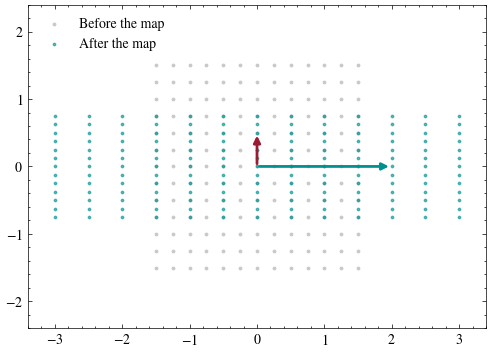
Stretch by \(2\) along \(x\), squash by \(\tfrac12\) along \(y\). Again, read the columns.
A photo is just a lot of points
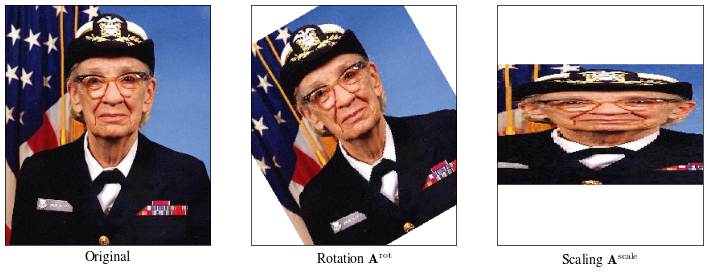
Every pixel has a coordinate, so a \(2 \times 2\) matrix can move a whole photograph. To warp an image we run the map backwards: for each output pixel, ask \(\mathbf{A}^{-1}\) which input pixel it came from.
img = plt.imread(cbook.get_sample_data("grace_hopper.jpg"))[::2, ::2]def warp(img, A): H, W = img.shape[:2] ys, xs = np.mgrid[0:H, 0:W] xc, yc = xs - W /2, H /2- ys # pixel indices -> centered xy coordinates Ainv = np.linalg.inv(A) u = Ainv[0, 0] * xc + Ainv[0, 1] * yc # where did this output point come from? v = Ainv[1, 0] * xc + Ainv[1, 1] * yc xi, yi = np.round(u + W /2).astype(int), np.round(H /2- v).astype(int) ok = (0<= xi) & (xi < W) & (0<= yi) & (yi < H) out = np.full_like(img, 255) out[ys[ok], xs[ok]] = img[yi[ok], xi[ok]]return outfig, axes = plt.subplots(1, 3, figsize=(9, 3.4))for ax, M, label in [(axes[0], np.eye(2), "Original"), (axes[1], A_rot, "Rotation $\\mathbf{A}^{\\mathrm{rot}}$"), (axes[2], A_scale, "Scaling $\\mathbf{A}^{\\mathrm{scale}}$")]: ax.imshow(warp(img, M)) ax.set_xlabel(label) ax.set_xticks([]) ax.set_yticks([])plt.show()
What if the columns become parallel?
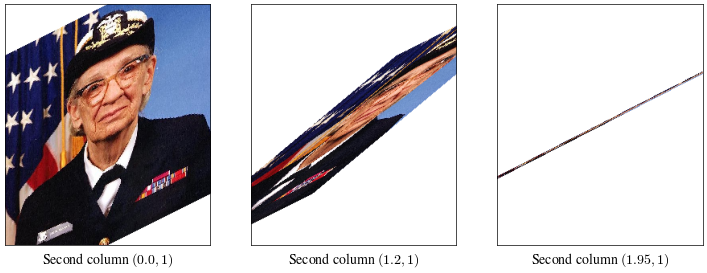
Your turn: edit the matrices below and try your own rotations, stretches, and combinations. All three share the first column \((1, 0.5)\), while the second column slides to the right toward \((2, 1)\), which is exactly twice the first. At \((2, 1)\) the matrix is the reading’s \(\mathbf{A}^{\mathrm{flat}}\), which has no inverse, so we stop just short of it. Watch what happens to the photo as the two columns approach parallel.
fig, axes = plt.subplots(1, 3, figsize=(9, 3.4))for ax, a inzip(axes, [0.0, 1.2, 1.95]): # try your own values; a = 2.0 is singular M = np.array([[1.0, a], [0.5, 1.0]]) ax.imshow(warp(img, M)) ax.set_xlabel(f"Second column $({a}, 1)$") ax.set_xticks([]) ax.set_yticks([])plt.show()
As the second column closes in on twice the first, the photo is squeezed onto a single line. A rank-\(1\) matrix keeps one dimension of the plane and throws the other away, which is why only full-rank matrices have inverses: no function can un-collapse a line back into a photograph.
Punchline: a matrix is a function; its columns say where the basis vectors go, and its rank says how much of the space survives. Next lecture we hunt for the directions a matrix merely stretches, its eigenvectors.